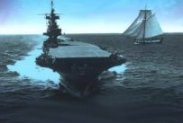
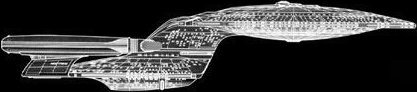
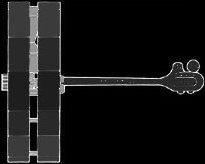
18) - 1936-1958 Aircraft Carrier CV-6 (USA)
(Yorktown class, sister ships: Yorktown, CV-5 and Hornet, CV-8)
Known as "The Big E". Arguably the most successful warship in history, I feel certain that this is the ship for which NCC-1701 is named. The full entry for CV-6 from the Dictionary of American Naval Fighting Ships is available on-line. Also check out the Enterprise (CV-6) Association web page.
Displacement: 19,800 tons Standard, 25,500 full load (original) 32,060 full load (later)
Length: 809' 6" (later 827' 5")
Beam: 83' (later 95' 5") at waterline, 108' 11" (later 114' 2") flight deck
Draught: 21' 8" (std) 27' 11" (full)
Propulsion: 9 geared steam turbines, 9 Babcock & Wilcox boilers (400 PSI) 120,000 SHP (4 shafts) = 32.5 knots
Compliment: 1889 (peace) 2919 (war)
Armament: 8 5"/L38 guns, 16 1.1" guns, (original) 8 5"/L38 guns, 44 40mm guns, 60 20mm guns (later)
Aircraft: 81-90 (1945)
Builder: Newport News SBDD, Newport News, VA
Laid Down: 16 July 1934
Launched: 3 October 1936
Commissioned: 12 May 1938
15 June 1938: first aircraft operations conducted on board.
18 July 1938: unmoored from Pier at Norfolk, proceed on shakedown cruise to Rio de Janerio. On way down she stops at Puerto Rico and Haiti as goodwill.
20 August 1938: Enterprise crosses equator at Longitude 37 degrees 00 minutes west.
20 September 1938: Enterprise leaves Brazil and stops at Cuba to pick up mail. While enroute: they are hit by a powerful hurricane off of Cape Hatteras. They then docked two days later at Hampton Roads: Virginia. She was put to get a minor overhaul and readied for spring war maneuvers.
25 October 1938: the ship leaves port and heads north. Off of Cape Cod, the ship encounters a fierce storm.
21 December 1938: Given to Captain Charles A. Pownall.
9 January 1939: under way in convoy with USS Yorktown.
6-9 March 1939: visit to Fort De France, Martinique.
1-14 April 1939: inport Hampton Roads taking on supplies
15 April 1939: President gives command to the fleet to head to the Pacific.
19 April 1939: Enterprise puts to sea.
26 April 1939: enters the Caribbean and passes through Panama Canal.
2 May 1939: arrived San Diego.
1 July 1939: underway from San Diego for scheduled excersises.
July 1939: she was anchored at the Golden Gates International Exposition.
August-September 1939: exercises conducted off S.California coast.
October 1939: underway to Hawaii. Assigned Hawaiian Det, Battle Force, serving as Flagship for ComScoFleet. She is moored at Pearl Harbor.
August-November 1940: excersises in Hawaiian waters.
November 1940: Hawaii to San Diego, then on to Bremerton.
January 1941: Bremerton to San Diego, then on to Pearl.
February 1941: Pearl to San Diego, then to Bremerton.
April 1941: Bremerton to San Diego, to Long Beach, then to Pearl. Back to San Diego.
May 1941: San Diego to Pearl.
August 1941: Pearl to Johnston Island and back to Pearl.
28 November 1941: CV-6 and Battle Group head for Wake Island to leave off Marine Fighting Squadron 211. Vice Admiral William F. Halsey in charge of group, with 3 Heavy Cruisers and 6 Destroyers. On board is 18 TBD Devastators of Torpedo 6, 36 SBD Dauntless of Scout and Bomb 6 and 18 F4F-3 Wildcats of Fighting 6.
30 November 1941: reached International Dateline.
4 December: 12 Marine fighters are launched for Wake Island. (Japanese intelligence at this time reports that as of 28 November Enterprise is still at Pearl.)
7 December 1941: First American carrier to return to Pearl Harbor after Japanese attack. Four dive bombers from Enterprise shot down by gunners at Ford Island, mistaking them for Japanese planes.
10 December 1941: Sank submarine I-70.
11 January 1942: Samoa convoy
1 February 1942: Marshall Islands. Raided Japanese bases at Kwajelein, Wotje, and Maloelap. Sank one transport, damaged 9 other ships. Japanese atoll commander killed.
8-25 April 1942: Escorted USS Hornet for Doolittle's Tokyo Raid. B-25 bombers from the USS Hornet bomb the Japanese capital. USS Enterprise provides combat air patrol.
4-6 June 1942: Battle of Midway. In this critical battle, US forces under Admiral Raymond Spruance decisively defeated a larger Japanese carrier force under Admiral Chuichi Nagumo. This defeat ended Japan's hopes for conquest of the Pacific. Aircraft from USS Enterprise at least partially responsible for three Japanese carriers sunk. Also sank the damaged heavy cruiser Mikuma.
4 June 1942
4:30 AM: Japanese launch strikes on Midway Island.
8:37 - 9:05 AM: Japanese recover aircraft.
9:30 - 10:24 AM: Three waves of American TBD torpedo bombers from the USS Enterprise and the USS Hornet fail to hit Japanese carriers.
10:26 AM: American SBD dive bombers from the USS Enterprise attack heavy carriers Kaga and Akagi. Caught with planes refueling and rearming on their decks, the Japanese carriers were set afire, and their offensive power was destroyed. SBD dive bombers from the USS Yorktown seriously damage light carrier Soryu. Soryu is quickly sunk by submarine USS Nautilus
2:45 PM: Two torpedo bombers from Hiryu hit the USS Yorktown
3:30 PM: USS Enterprise launches 24 SBD dive bombers (including 10 from the damaged USS Yorktown) against Hiryu
5:00 PM: SBD dive bombers attack Hiryu
7:25 PM:Kaga sinks from damage.
5 June 1942
5:00 AM: Akagi, too badly damaged to be saved, scuttles.
9:00 AM: Hiryu, too badly damaged to be saved, scuttles.
6 June 1942
6:00 AM: Yorktown, sunk by submarine I-168.
NOTE: Contrary to Okuda's entry for Repulse in "The Star Trek Encyclopedia", HMS Repulse was not involved in this action. HMS Repulse was sunk 10 December 1941 by Japanese torpedo bombers near Singapore.
24 August 1942: Battle of the Eastern Solomons. Enterprise sank light carrier Ryujo(?) (other sources credit USS Saratoga) Enterprise damaged by three bombs, killing 74, wounding 95.
26 October 1942: Battle of Santa Cruz Islands. Enterprise hit by three bombs, killing 44, wounding 75, but kept fighting. USS Enterprise might easily have been sunk had it not been for the anti-aircraft gunfire of the battleship USS South Dakota, which shot down a record 26 aircraft that day, a record which still stands.
30 October-11 November 1942: Partial repairs at Noumea, New Caledonia
13 November 1942: Severely damaged battlecruiser Hiei.
14 November 1942: Sank heavy cruiser Kinugasa.
16 November-4 December 1942: Repairs completed at Noumea.
27 May 1943: Awarded Presidential Unit Citation
20 July 1943 - November 1943 : Refitted at Puget Sound
29 January-3 February 1944: Supported landings on Kwajelein. First radar controlled night bombing mission launched from a carrier.
6 June 1944: Left Majuro for the Marianas.
19-20 June 1944: First Battle of the Phillipine Sea, AKA The Great Marianas Turkey Shoot. Approximately 400 Japanese aircraft destroyed by planes from the Enterprise and other US carriers, and by anti-aircraft guns from other US ships.
24-26 October 1944: Battle of Leyte Gulf. This was the largest naval battle of all time. It was so large, that historians usually subdivide it into several smaller battles, such as the Battle off Cape Engano, the Battle of the Sibuyan Sea, the Battle off Samar, the Battle of the Surigao Strait, etc. USS Enterprise was part of the Third Fleet's famous Task Force 38, specifically TG 38.4.
24 October 1944: Battle of the Sulu Sea. Planes from Enterprise spot Japanese southern force, attack battleship Fuso.
24 October 1944: Battle of the Sibuyan Sea. Planes from the USS Enterprise, the USS Essex, the USS Intrepid, USS Cabot, and USS Franklin sink the battleship Musashi. Heavy cruiser Myoko damaged.
25 October 1944: Battle off Cape Engano. Partially responsible for sinking carrier Zuikaku and light carrier Zuiho.
6 December 1944: Returned to Pearl Harbor.
7 April 1945: One of six carriers which sank the battleship Yamato.
11 April 1945: Slightly damaged by kamikaze.
14 May 1945: Seriously damaged by kamikaze. 14 killed, 34 wounded. Forward elevator destroyed.
7 June-13 September 1945: Repairs at Puget Sound.
17 October 1945: Arrives in New York.
1 November 1945-18 January 1946: Operation Magic Carpet. Returned over 10,000 veterans to USA.
18 January 1946: Entered New York Naval Shipyard for inactivation.
17 February 1947: Decommissioned
1949: Plan by New York State to convert ship into a museum is suspended.
January 1957: Stricken from the Naval Vessels Register.
1957-8: Plan by Enterprise Association to preserve the ship fails.
1 July 1958: Sold
1958-1960: Scrapped at Kearney, New Jersey. Nameplate from the stern preserved at River Vale, New Jersey, where it remains to this day.
Sources:
Aircraft Carriers of the U.S. Navy
The Battle of Leyte Gulf: 24-26 October 1944
Dictionary of American Naval Fighting Ships, pg 356-358
History of the Vessel Enterprise
Jane's Fighting Ships of World War II
The Two Ocean War
U.S. Aircraft Carriers: An Illustrated Design History
Warships of the Imperial Japanese Navy, 1869-1945